



Early in 1839, following their release from the quarantine imposed upon the Maitland, the Fairhall family consisting of William, Anne and their children, left Sydney and travelled north, headed for the 'Paterson River'. I believe that they probably travelled to the Hunter by ship from Sydney, and that William was possibly accepting a job offer on a district farm, arranged by the Parish Council back home in Brede before they left or believed that there were job opportunities. Their son Thomas, (according to the Return of Dispersal of Immigrants compiled by Surgeon Smith) had gone to the Illawarra with George Wenham, another 'Maitland' passenger.
Their destination was Morpeth, a village known until 1834 as Green Hills, and an important port for the Hunter district and northern New South Wales primary industries due to its Hunter River location. The survey carried out in 1833 by G.B. White showed there were eight wharves at Morpeth, and in the 1848 issue of the Geographical Dictionary or Gazetteer of the Australian Colonies, by W H Wells, Morpeth was nineteenth largest town in the Colony, with 630 people in residence.
Morpeth, like nearby Hexham and Newcastle, was named after the town in the English county of Northumberland, and the two towns are remarkably similar in their history, the geography of the surrounding district, the influence of the railway, nearness to coal fields and their industrial development.
Newcastle (King's Town) had been established at the mouth of the Hunter River in 1801 as a loading centre for coal for shipping, and from 1804 to 1823 Newcastle was a penal settlement for incorrigibles. The use of convict labour, especially for road building, was wide spread, and in 1838 there were 91 convicts stationed at Harper's Hill (Lochinvar) and 97 at Morpeth, of whom 83 were in irons. By 1836, Newcastle had a population of 704, and there were 426 convicts housed there.
Almost every new settler who sought his fortune in the vast area of the Hunter Valley, the highlands to the north, the plains to the north-west and even the Darling Downs of Queensland landed at Morpeth. Everything required from Sydney or abroad was first brought here,and every bale of wool and every sheepskin, every cask of tallow and every hide - everything in fact that was destined for export - had to be shipped first at Morpeth and later transhipped at Sydney if it were destined for a market abroad. Men and women going to Sydney for business and pleasure left from Morpeth, and those returning north or going north probably also landed there, usually at Queen's Wharf.
An advertisement for the steam vessel "William the Fourth" in February 1832 read as follows:
Much of the area had been cleared by Edward Close, who had obtained local land grants of 1030, 1020 and 560 acres to farm and erect a home. Close was a local Magistrate 1824 - 1827, a Member of the NSW Legislative Council 1829 - 1838, and First Warden of the Maitland District Council 1843 - 1852. The present town of Morpeth stands on land that originally belonged to the Close family.
The Close family homes were later sold and used by the Anglican Church as a residence for the Bishop of Newcastle, as a theological training college and as a boys' school. Over the years, the Close family sold quite a few single blocks for residential homes in the village. Benjamin Fairhall purchased a block in High Street in 1855 from Edward and Susannah Close, and a similar sale was made to William Fairhall the same year. A major Land Auction was held on 30 October 1920 which ended most of the Close family's ownership in the village area and opened the way for more development.
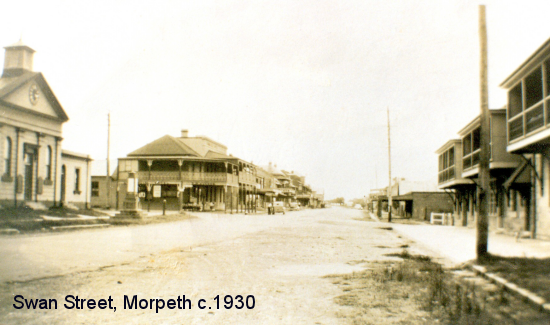
The first school opened in 1836, and St James Anglican Church was commenced the following year. By 1847 there were 630 people living in the township. Morpeth Public School opened in 1862. Residential lots of land were offered for sale, and the town prospered, with shops, banks, inns and hotels, bonded store, Customs offices, post office, steam mill, soap works, churches, court house, newspaper, a foundry and, in 1864, a railway line to Newcastle. Mr William Arnott's Bakery in Swan Street was the business which later became the national icon Arnott's Biscuits.
The Municipality of Morpeth was declared in 1866, and served the district well until 1944 when it was merged with Maitland Shire Council. During those great days, the railway carried freight to Morpeth wharves, where it was loaded onto the ships, mostly paddle wheelers, but the restriction of shipping due to the building of bridges, and the advent of efficient road transport, led to the closing of the rail line in 1953.
Morpeth is home for many who work in either Maitland or in the city of Newcastle, and in the last few years it has developed as a crafts centre, popular with weekend visitors and tourists visiting the Hunter Valley. Many of the older buildings, especially in Swan Street, have been refurbished. Older homes are being renovated throughout the village, and a major new development is planned on the site of St John's College and Closebourne House.
The conversion of the larger stores for use as craft shops and workshops, and other attractions, have changed the whole nature of the town. An annual Jazz Festival at Morpeth - in venues and in the streets, also attracts a large crowd of visitors.
Many of the local buildings are listed by the National Trust, and careful restoration has preserved them for the future. Unfortunately the major wharves have now been removed or fallen into disrepair, but history lives on in the streets of the town.
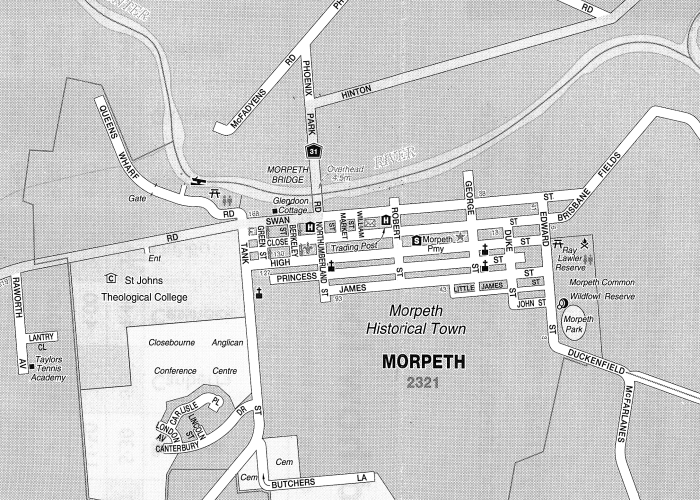
A large number of events in our family history are recorded at Morpeth, and it was home to around seven generations of Fairhalls, most of whom seemed to have been tradespersons or artisans. The family worshipped at St James Anglican Church, the building generously donated by Edward Close in 1837, at a recorded cost of £1,441.2.11. Mr Charles Fairhall was a Warden of the Church, and, as a Tiler and Plasterer, laid the ceramic tiles in the foyer. In later years, this church was extended, and it features a cut stone pulpit, a pipe organ, cedar pews and a beautiful stained glass window on the east wall (as a memorial to Mr Close - erected in 1871).
The early generations had births, deaths and marriages registered as having occurred at Anambah, a large property to the west of Morpeth, at Lochinvar, Branxton, Maitland and other district localities, so it is apparent that family members lived and worked throughout the Hunter. The original immigrant couple, William and his wife Ann, are buried in the Anglican portion of Morpeth Cemetery, along with many of their descendants.
Although there are many Fairhalls still living today throughout the Hunter region, I believe there are no persons with that surname actually living in Morpeth today.